What Are Different Forms of Art and Why Are They Important
The arts are a very wide range of homo practices of artistic expression, storytelling and cultural participation. They encompass multiple various and plural modes of thinking, doing and beingness, in an extremely wide range of media. Both highly dynamic and a characteristically constant feature of human life, they accept developed into innovative, stylized and sometimes intricate forms. This is oft accomplished through sustained and deliberate study, preparation and/or theorizing within a detail tradition, across generations and even betwixt civilizations. The arts are a vehicle through which human beings cultivate singled-out social, cultural and individual identities, while transmitting values, impressions, judgments, ideas, visions, spiritual meanings, patterns of life and experiences across time and space.
Prominent examples of the arts include compages, visual arts (including ceramics, drawing, filmmaking, painting, photography, and sculpting), literary arts (including fiction, drama, poesy, and prose), performing arts (including dance, music, and theatre), textiles and fashion, folk art and handicraft, oral storytelling, conceptual and installation art, criticism, and culinary arts (including cooking, chocolate making and winemaking). They tin can employ skill and imagination to produce objects, performances, convey insights and experiences, and construct new environments and spaces.
The arts tin can refer to common, popular or everyday practices besides equally more sophisticated and systematic, or institutionalized ones. They can be discrete and self-contained, or combine and interweave with other art forms, such as the combination of artwork with the written word in comics. They tin too develop or contribute to some detail attribute of a more complex fine art form, as in cinematography.
By definition, the arts themselves are open to being continually re-divers. The practice of modern art, for instance, is a testament to the shifting boundaries, improvisation and experimentation, reflexive nature, and self-criticism or questioning that art and its atmospheric condition of production, reception, and possibility tin undergo.
As both a means of developing capacities of attention and sensitivity, and as ends in themselves, the arts can simultaneously be a class of response to the earth, and a style that our responses, and what nosotros deem worthwhile goals or pursuits, are transformed. From prehistoric cave paintings, to ancient and contemporary forms of ritual, to modern-twenty-four hours films, art has served to register, embody and preserve our ever shifting relationships to each other and to the earth.
Definition
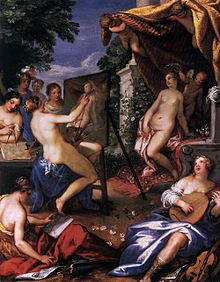
There are several possible meanings for the definitions of the terms Art and Arts.[a] The first significant of the word fine art is « way of doing ».[ane] The most basic nowadays meaning defines the arts equally specific activities that produce sensitivity in humans.[2] The arts are likewise referred to every bit bringing together all creative and imaginative activities, without including scientific discipline.[b] [three] [iv] In its almost basic abstract definition, art is a documented expression of a sentient being through or on an accessible medium then that anyone can view, hear or experience it. The act itself of producing an expression tin also exist referred to as a sure art, or equally fine art in general. Whether this solidified expression, or the act of producing it, is "skillful" or has value depends on those who access and rate it. Such public rating is dependent on various subjective factors. Merriam-Webster defines "the arts" as "painting, sculpture, music, theatre, literature, etc., considered equally a group of activities washed by people with skill and imagination."[five] Similarly, the United States Congress, in the National Foundation on the Arts and Humanities Human action, defined "the arts" as follows:
The term "the arts" includes, simply is not limited to, music (instrumental and vocal), dance, drama, folk art, creative writing, architecture and allied fields, painting, sculpture, photography, graphic and craft arts, industrial design, costume and fashion design, motion pictures, television, radio, film, video, tape and sound recording, the arts related to the presentation, performance, execution, and exhibition of such major art forms, all those traditional arts practiced by the various peoples of this country. (sic) and the study and awarding of the arts to the human environment.[6]
Art is a global activity in which a large number of disciplines are included, such equally: fine arts, liberal arts, visual arts, decorative arts, applied arts, design, crafts, performing arts,[3] ... Nosotros are talking about "the arts" when several of them are mentioned: "As in all arts the enjoyment increases with the knowledge of the art".[7]
The arts can exist divided into several areas, the fine arts which join, in the broad sense, all the arts whose aim is to produce truthful artful pleasure,[eight] decorative arts and applied arts which relate to an aesthetic side in everyday life.[ix]
History

The earliest surviving form of any of the arts are cave paintings, perhaps from seventy,000 BCE, but definitely from at to the lowest degree 40,000 BCE.[x] The oldest known musical musical instrument, the purported Divje Infant Flute—made from a young cavern bear femur—is dated to 43,000 and 82,000 BCE, only whether it is truly a musical instrument (or an object created by animals) remains extremely controversial.[xi] The earliest objects whose designations as musical instruments are widely accepted are viii bone flutes from the Swabian Jura, Germany; three of these from the Geissenklösterle are dated every bit the oldest, c. 43,150–39,370 BP.[12] The earliest surviving literature appears much later on; the Instructions of Shuruppak and Kesh temple hymn among other Sumerian cuneiform tablets, are idea to only be from 2600 BCE.[13]
In Ancient Greece, all art and craft was referred to by the same word, techne. Thus, in that location was no distinction among the arts. Ancient Greek art brought the veneration of the creature form and the development of equivalent skills to show musculature, poise, beauty, and anatomically correct proportions. Ancient Roman fine art depicted gods every bit idealized humans, shown with feature distinguishing features (e.g. Zeus' thunderbolt). In Byzantine and Gothic art of the Eye Ages, the potency of the church insisted on the expression of biblical truths. Eastern fine art has mostly worked in a fashion akin to Western medieval art, namely a concentration on surface patterning and local colour (meaning the obviously color of an object, such as basic ruby for a ruby-red robe, rather than the modulations of that colour brought about by light, shade and reflection). A characteristic of this style is that the local colour is ofttimes defined by an outline (a contemporary equivalent is the cartoon). This is evident in, for example, the art of India, Tibet and Nippon. Religious Islamic art forbids iconography, and instead expresses religious ideas through calligraphy and geometrical designs.
Classifications
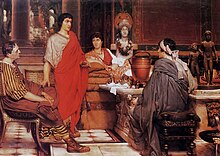
In the Eye Ages, the Artes Liberales (liberal arts) were taught in universities as function of the Trivium, an introductory curriculum involving grammer, rhetoric, and logic,[14] and of the Quadrivium, a curriculum involving the "mathematical arts" of arithmetic, geometry, music, and astronomy.[xv] The Artes Mechanicae (consisting of vestiaria – tailoring and weaving; agricultura – agriculture; architectura – compages and masonry; militia and venatoria – warfare, hunting, military education, and the martial arts; mercatura – trade; coquinaria – cooking; and metallaria – blacksmithing and metallurgy)[16] [ non specific plenty to verify ] were practised and developed in guild environments. The modern distinction between "artistic" and "not-artistic" skills did not develop until the Renaissance. In modern academia, the arts are usually grouped with or as a subset of the humanities. Some subjects in the humanities are history, linguistics, literature, theology, philosophy, and logic.
The arts have besides been classified every bit seven: painting, compages, sculpture, literature, music, performing and cinema. Some view literature, painting, sculpture, and music as the primary four arts, of which the others are derivative; drama is literature with acting, trip the light fantastic toe is music expressed through motion, and song is music with literature and voice.[17] Moving picture is sometimes called the "eighth" and comics the "ninth art".[18]
Visual arts
Architecture

Compages is the fine art and scientific discipline of designing buildings and structures. The give-and-take architecture comes from the Greek arkhitekton, "principal builder, director of works," from αρχι- (arkhi) "main" + τεκτων (tekton) "builder, carpenter".[19] A wider definition would include the blueprint of the congenital environment, from the macrolevel of town planning, urban design, and landscape architecture to the microlevel of creating furniture. Architectural pattern commonly must address both feasibility and toll for the builder, as well equally part and aesthetics for the user.
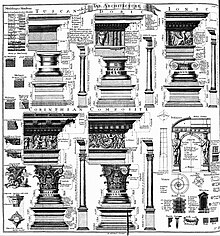
In modern usage, architecture is the art and discipline of creating, or inferring an implied or apparent plan of, a circuitous object or arrangement. The term can be used to connote the implied architecture of abstruse things such every bit music or mathematics, the credible compages of natural things, such as geological formations or the structure of biological cells, or explicitly planned architectures of man-fabricated things such every bit software, computers, enterprises, and databases, in addition to buildings. In every usage, an architecture may be seen as a subjective mapping from a human perspective (that of the user in the case of abstruse or physical artifacts) to the elements or components of some kind of structure or organisation, which preserves the relationships amongst the elements or components. Planned architecture manipulates space, volume, texture, light, shadow, or abstract elements in guild to achieve pleasing aesthetics. This distinguishes it from applied science or technology, which commonly concentrate more on the functional and feasibility aspects of the design of constructions or structures.
In the field of building architecture, the skills demanded of an architect range from the more than complex, such as for a hospital or a stadium, to the apparently simpler, such as planning residential houses. Many architectural works may be seen also as cultural and political symbols, or works of fine art. The role of the architect, though changing, has been central to the successful (and sometimes less than successful) design and implementation of pleasingly built environments in which people live.
Ceramics
Ceramic art is art made from ceramic materials (including clay), which may have forms such equally pottery, tile, figurines, sculpture, and tableware. While some ceramic products are considered fine art, some are considered to be decorative, industrial, or applied art objects. Ceramics may as well exist considered artefacts in archaeology. Ceramic art tin can exist made past one person or by a group of people. In a pottery or ceramic factory, a grouping of people design, manufacture, and decorate the pottery. Products from a pottery are sometimes referred to as "art pottery." In a i-person pottery studio, ceramists or potters produce studio pottery. In modernistic ceramic technology usage, "ceramics" is the fine art and science of making objects from inorganic, non-metallic materials past the action of estrus. It excludes drinking glass and mosaic made from glass tesserae.
Conceptual art
Conceptual art is art wherein the concept(s) or thought(s) involved in the work take precedence over traditional aesthetic and material concerns. The inception of the term in the 1960s referred to a strict and focused practice of idea-based art that often defied traditional visual criteria associated with the visual arts in its presentation as text.[20] Through its clan with the Young British Artists and the Turner Prize during the 1990s,[21] its popular usage, particularly in the United Kingdom, developed as a synonym for all contemporary art that does not practise the traditional skills of painting and sculpture.
Drawing
Drawing is a means of making an image, using whatsoever of a wide diverseness of tools and techniques. It generally involves making marks on a surface past applying pressure from a tool, or moving a tool beyond a surface. Common tools are graphite pencils, pen and ink, inked brushes, wax colour pencils, crayons, charcoals, pastels, and markers. Digital tools which tin simulate the effects of these are likewise used. The main techniques used in drawing are line drawing, hatching, crosshatching, random hatching, scribbling, stippling, and blending. An creative person who excels in drawing is referred to as a drafter, draftswoman, or draughtsman.[22] Cartoon can be used to create fine art used in cultural industries such equally illustrations, comics and animation. Comics are often called the "ninth fine art" (le neuvième art) in Francophone scholarship, adding to the traditional "Vii Arts".[23]
Painting

Painting is a style of creative expression, and tin exist done in numerous forms. Drawing, gesture (as in gestural painting), composition, narration (as in narrative art), or abstraction (as in abstract art), among other aesthetic modes, may serve to manifest the expressive and conceptual intention of the practitioner.[24] Paintings can be naturalistic and representational (as in a notwithstanding life or landscape painting), photographic, abstract, narrative, symbolistic (equally in Symbolist art), emotive (as in Expressionism), or political in nature (equally in Artivism).
Modern painters have extended the practice considerably to include, for example, collage. Collage is not painting in the strict sense since it includes other materials. Some modern painters incorporate different materials such equally sand, cement, straw, wood or strands of hair for their artwork texture. Examples of this are the works of Elito Circa, Jean Dubuffet or Anselm Kiefer.
Photography
Photography equally an art form refers to photographs that are created in accord with the creative vision of the photographer. Art photography stands in dissimilarity to photojournalism, which provides a visual account for news events, and commercial photography, the principal focus of which is to advertise products or services.
Sculpture
Sculpture is the branch of the visual arts that operates in iii dimensions. It is one of the plastic arts. Durable sculptural processes originally used etching (the removal of material) and modelling (the add-on of textile, every bit clay), in stone, metal, ceramics, wood and other materials; but since modernism, shifts in sculptural process led to an well-nigh complete freedom of materials and process. A wide multifariousness of materials may exist worked by removal such as carving, assembled by welding or modelling, or moulded, or cast.
Literary arts
Literature is literally "associate with letters" every bit in the first sense given in the Oxford English language Dictionary. The noun "literature" comes from the Latin word littera significant "an individual written character (letter)." The term has generally come up to identify a collection of writings, which in Western culture are mainly prose (both fiction and non-fiction), drama and poetry. In much, if non all of the earth, the creative linguistic expression can be oral as well, and include such genres equally epic, legend, myth, ballad, other forms of oral poetry, and as folktale. Comics, the combination of drawings or other visual arts with narrating literature, are often chosen the "ninth art" (le neuvième fine art) in Francophone scholarship.[23]
Performing arts
Performing arts comprise dance, music, theatre, opera, mime, and other fine art forms in which a homo performance is the principal product. Performing arts are distinguished past this performance element in dissimilarity with disciplines such as visual and literary arts where the production is an object that does not require a performance to exist observed and experienced. Each subject field in the performing arts is temporal in nature, meaning the product is performed over a period of fourth dimension. Products are broadly categorized every bit being either repeatable (for example, by script or score) or improvised for each operation.[25] Artists who participate in these arts in front end of an audience are called performers, including actors, magicians, comedians, dancers, musicians, and singers. Performing arts are also supported past the services of other artists or essential workers, such as songwriting and stagecraft. Performers frequently accommodate their appearance with tools such as costume and stage makeup.
Dance

Trip the light fantastic toe (from Quondam French dancier, of unknown origin) generally refers to human movement either used every bit a form of expression or presented in a social, spiritual or functioning setting.[26] Trip the light fantastic toe is also used to depict methods of non-verbal communication (see trunk language) between humans or animals (e.g. bee dance, mating dance), move in inanimate objects (east.m. the leaves danced in the wind), and sure musical forms or genres. Choreography is the fine art of making dances, and the person who does this is called a choreographer. Definitions of what constitutes dance are dependent on social, cultural, aesthetic, artistic and moral constraints and range from functional movement (such as Folk trip the light fantastic) to codified, virtuoso techniques such as ballet. In sports, gymnastics, figure skating and synchronized swimming are dance disciplines while Martial arts "kata" are frequently compared to dances.
Music

Music is an art form whose medium is sound and silence, occurring in time. Common elements of music are pitch (which governs melody and harmony), rhythm (and its associated concepts tempo, metre, and articulation), dynamics, and the sonic qualities of timbre and texture. The creation, performance, significance, and fifty-fifty the definition of music vary according to culture and social context. Music ranges from strictly organized compositions (and their reproduction in performance) through improvisational music to aleatoric pieces. Music can be divided into genres and subgenres, although the dividing lines and relationships between music genres are often subtle, sometimes open to individual interpretation, and occasionally controversial. Within "the arts", music may be classified equally a performing art, a fine art, and auditory fine art.
Theatre
Theatre or theater (from Greek theatron (θέατρον); from theasthai, "behold"[27]) is the branch of the performing arts concerned with acting out stories in front of an audience using combinations of speech, gesture, music, trip the light fantastic toe, sound and spectacle – indeed, whatever one or more elements of the other performing arts. In addition to the standard narrative dialogue fashion, theatre takes such forms as opera, ballet, mime, kabuki, classical Indian trip the light fantastic toe, Chinese opera and mummers' plays.
Multidisciplinary creative works
Areas exist in which artistic works incorporate multiple creative fields, such as motion picture, opera and performance art. While opera is oft categorized in the performing arts of music, the discussion itself is Italian for "works", considering opera combines several creative disciplines in a singular artistic experience. In a typical traditional opera, the unabridged work utilizes the following: the sets (visual arts), costumes (style), interim (dramatic performing arts), the libretto, or the words/story (literature), and singers and an orchestra (music).
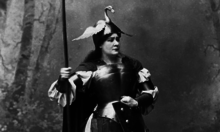
The composer Richard Wagner recognized the fusion of so many disciplines into a single work of opera, exemplified by his cycle Der Band des Nibelungen ("The Ring of the Nibelung"). He did not use the term opera for his works, merely instead Gesamtkunstwerk ("synthesis of the arts"), sometimes referred to as "Music Drama" in English, emphasizing the literary and theatrical components which were as of import every bit the music. Classical ballet is another course which emerged in the 17th century in which orchestral music is combined with dance.
Other works in the late 19th, 20th and 21st centuries have fused other disciplines in unique and creative ways, such every bit performance art. Functioning art is a operation over time which combines any number of instruments, objects, and art within a predefined or less well-divers construction, some of which can be improvised. Performance art may be scripted, unscripted, random or carefully organized; even audience participation may occur. John Cage is regarded past many as a operation artist rather than a composer, although he preferred the latter term. He did not etch for traditional ensembles. Muzzle's limerick Living Room Music composed in 1940 is a "quartet" for unspecified instruments, really non-melodic objects, which tin can be found in a living room of a typical house, hence the title.
Other arts
There is no articulate line betwixt art and culture. Cultural fields similar gastronomy are sometimes considered as arts.[28]
Applied arts
The applied arts are the application of design and ornament to everyday, functional, objects to make them aesthetically pleasing.[29] The applied arts includes fields such every bit industrial pattern, illustration, and commercial fine art.[thirty] The term "practical art" is used in distinction to the fine arts, where the latter is divers equally arts that aims to produce objects which are beautiful or provide intellectual stimulation but have no primary everyday function. In practise, the two often overlap.
Video games
A debate exists in the fine arts and video game cultures over whether video games can be counted every bit an art course.[31] Game designer Hideo Kojima professes that video games are a type of service, not an art course, considering they are meant to entertain and attempt to entertain as many people every bit possible, rather than existence a single artistic vox (despite Kojima himself being considered a gaming auteur, and the mixed opinions his games typically receive). Still, he acknowledged that since video games are made up of artistic elements (for instance, the visuals), game designers could be considered museum curators – not creating artistic pieces, simply arranging them in a manner that displays their artistry and sells tickets.
Within social sciences, cultural economists show how video games playing is conducive to the interest in more than traditional art forms and cultural practices, which suggests the complementarity between video games and the arts.[32]
In May 2011, the National Endowment of the Arts included video games in its redefinition of what is considered a "work of art" when applying for a grant.[33] In 2012, the Smithsonian American Fine art Museum presented an exhibit, The Fine art of the Video Game.[34] Reviews of the exhibit were mixed, including questioning whether video games belong in an fine art museum.
Arts criticism
- Compages criticism
- Art criticism
- Dance criticism
- Film criticism
- Music criticism
- Idiot box criticism
- Theatre criticism
- Literary criticism
Run into also
- Arts in educational activity
- The arts and politics
Notes
- ^ The term Fine art comes from the Latin ars, artis.
- ^ Historically, science has long been opposed to fine art, because art was characterised as a subject area that could not exist learned (different science).
References
- ^ Valéry 1935, p. 683.
- ^ "Définition de l'art" [Definition of art] (in French). Éditions Larousse. Archived from the original on 31 March 2021. Retrieved seven June 2020.
- ^ a b "Art Definition: Pregnant, Classification of Visual Arts". visual-arts-cork.com. Archived from the original on 30 May 2020. Retrieved vii June 2020.
- ^ "The arts definition and pregnant". Collins English Dictionary. Archived from the original on 11 July 2017. Retrieved 7 June 2020.
- ^ "Definition of The Arts past Merriam-Webster". Merriam-Webster. Archived from the original on one June 2017. Retrieved fourteen May 2017.
- ^ Van Camp 2006.
- ^ Hemingway 2003, p. 11.
- ^ "Définition de Beaux-Arts" [Definition of Fine Arts] (in French). Bayard Presse. Archived from the original on 8 June 2020. Retrieved 8 June 2020.
The fine arts include painting, sculpture, certain graphic arts and architecture. Music and verse are sometimes called fine art.
- ^ "Définition de arts appliqués" [Definition of applied arts] (in French). L'Internaute. Archived from the original on 8 June 2020. Retrieved 8 June 2020.
The applied arts bring together under one banner all the activities that bring an artful side to everyday life. These arts are practiced by designers, who are in accuse of embellishing what surrounds the individual.
- ^ St. Fleur 2018, p. 10.
- ^ Morley 2013, pp. 38–39.
- ^ Morley 2013, pp. 42–43.
- ^ Diedrich 2015, p. 1.
- ^ Onions, Friedrichsen & Burchfield 1991, p. 994.
- ^ . The New International Encyclopædia. 1905 – via Wikisource.
The quadrivium consisted of arithmetic, music, geometry, and astronomy.
- ^ In his commentary on Martianus Capella's early on 5th century work, The Marriage of Philology and Mercury, one of the main sources for medieval reflection on the liberal arts
- ^ Rowlands & Landauer 2001.
- ^ Ryynänen, Max (2020). On the Philosophy of Primal European Art: The History of an Institution and Its Global Competitors. Lanham: Rowman & Littlefield. p. 37. ISBN978-one-7936-3418-iv.
- ^ Harper 2016.
- ^ LeWitt 1967, pp. 79–83.
- ^ Huntsman 2015, p. 221.
- ^ "The definition of draftsman". Dictionary.com. Archived from the original on 29 October 2016. Retrieved 29 October 2016.
- ^ a b Miller 2007, p. 23.
- ^ Perry 2014, p. 85.
- ^ Honderich 2006.
- ^ Fraleigh 1987, p. 3.
- ^ Harper, Douglas (2001–2016). "theater (n.)". Online Etymology Dictionary. Archived from the original on 30 Oct 2016. Retrieved 29 October 2016.
- ^ Desai, DeSimone & Henig 2013.
- ^ Chilvers 2004, p. 29.
- ^ "Ascertain Applied art at Dictionary.com". Dictionary.com. Archived from the original on 31 July 2017. Retrieved 8 May 2018.
- ^ Parker 2012, p. 42.
- ^ Borowiecki & Prieto-Rodriguez 2013, pp. 239–258.
- ^ Barber 2012.
- ^ Parker 2012, p. 46.
Sources
- Chilvers, Ian (2004). The Oxford Dictionary of Art (third ed.). Oxford: Oxford University Press. ISBN978-0-nineteen-860476-1.
- Fraleigh, Sondra Horton (1987). Dance and the Lived Body: A Descriptive Aesthetics. Pittsburgh, Pa.: University of Pittsburgh Press. ISBN978-0-8229-7170-two.
- Hemingway, Ernest (2003) [1932]. "ane". Expiry in the Afternoon (1st Scribner trade pbk. ed.). New York: Charles Scribner's Sons. ISBN978-0-684-85922-4.
- Honderich, Ted (2006). The Oxford companion to philosophy. Oxford University Press. doi:ten.1093/acref/9780199264797.001.0001. ISBN978-0-19-926479-7.
- Huntsman, Penny (28 September 2015). Thinking About Art: A Thematic Guide to Art History. Chichester, W Sussex, Great britain: Wiley. ISBN978-i-118-90517-3.
- Miller, Ann (2007). Reading bande dessinée : critical approaches to French-language comic strip. ISBN978-1-84150-177-ii.
- Morley, Iain (2013). The Prehistory of Music: Human Evolution, Archeology, and the Origins of Musicality. Oxford: Oxford Academy Press. ISBN978-0-19-923408-0.
- Onions, Charles Talbut; Friedrichsen, George Washington Salisbury; Burchfield, Robert William (1991). The Oxford dictionary of English etymology. Oxford: at The Clarendon Press. ISBN978-0-19-861112-7.
- LeWitt, Solomon (June 1967). "Paragraphs on Conceptual Art". Artforum. Vol. five, no. 10. Archived from the original on 26 July 2020. Retrieved 12 May 2020.
- Borowiecki, Karol J.; Prieto-Rodriguez, Juan (2013). "Video Games Playing: A substitute for cultural consumptions?". Journal of Cultural Economics. 39 (three): 239–258. CiteSeerXten.one.1.676.2381. doi:x.1007/s10824-014-9229-y. S2CID 49572910.
- Diedrich, Cajus 1000. (1 April 2015). "'Neanderthal bone flutes': simply products of Ice Age spotted hyena scavenging activities on cave bear cubs in European cave bear dens". Open up Science. 2 (4): 140022. Bibcode:2015RSOS....240022D. doi:x.1098/rsos.140022. PMC4448875. PMID 26064624.
- Parker, Felan (12 December 2012). "An Art Globe for Artgames". Loading... vii (11). ISSN 1923-2691. Archived from the original on 26 December 2016. Retrieved 14 May 2017.
- Perry, Lincoln (Summertime 2014). "The Music of Painting". The American Scholar. 83 (3).
- Hairdresser, Bonnie (16 Baronial 2012). "Professor Mary Flanagan Participates in White House Consortium". Darthmouth News. Archived from the original on 26 July 2020. Retrieved 13 May 2020.
- St. Fleur, Nicholas (12 September 2018). "Oldest Known Cartoon past Human Hands Discovered in South African Cave". The New York Times. Archived from the original on 14 Apr 2020. Retrieved vii April 2020.
- Desai, Trex; DeSimone, Frank; Henig, Sarit (xx Dec 2013). "The New Face up of French Gastronomy - Knowledge@Wharton". knowledge.wharton.upenn.edu. Wharton School of the University of Pennsylvania. Archived from the original on 12 September 2017. Retrieved 8 May 2018.
- "The Fine art of Video Games". SI.edu. Smithsonian American Fine art Museum. Archived from the original on ten Jan 2011. Retrieved 7 March 2015.
- "Conceptual art". Tate Glossary. Archived from the original on 20 March 2015. Retrieved 7 March 2015.
- "FY 2012 Arts in Media Guidelines". Endow.gov. National Endowment for the Arts. Archived from the original on 13 February 2012. Retrieved seven March 2015.
- Harper, Douglas (2016). "Origin and meaning of architect by Online Etymology Dictionary". Online Etymology Lexicon. Archived from the original on 19 March 2016. Retrieved 29 October 2016.
- Rowlands, Joseph; Landauer, Jeff (2001). "Esthetics". Importance of Philosophy. Archived from the original on 16 April 2016. Retrieved 28 October 2016.
- Van Camp, Julie (22 November 2006). "Congressional definition of "the arts"". PHIL 361I: Philosophy of Art. California State Academy, Long Beach. Archived from the original on 29 July 2016. Retrieved 28 October 2016.
- Valéry, Paul (1 November 1935). "Notion générale de fifty'fine art" [General concept of art] (PDF). Nouvelle Revue Française (in French). Vol. 24, no. 266. Paris: Éditions Gallimard. pp. 683–693. ISBN978-2-07-239508-6. Archived from the original on 8 June 2020. Retrieved eight June 2020.
Further reading
- Barron, Christina (29 Apr 2012). "Museum exhibit asks: Is it art if you button 'showtime'?". The Washington Post. Archived from the original on 4 June 2013. Retrieved 12 February 2013.
- Feynman, Richard (1985). QED: The Strange Theory of Light and Thing . Princeton University Press. ISBN978-0-691-02417-two.
- Gibson, Ellie (24 January 2006). "Games aren't art, says Kojima". Eurogamer. Gamer Network. Archived from the original on ix March 2015. Retrieved 7 March 2015.
- Kennicott, Philip (18 March 2012). "The Art of Video Games". The Washington Post. Archived from the original on 4 June 2013. Retrieved 12 February 2013.
External links
-
 Media related to The arts at Wikimedia Commons
 - Topic Dictionaries at Oxford Learner'south Dictionaries
- Definition of Art by Lexico
Source: https://en.wikipedia.org/wiki/The_arts
0 Response to "What Are Different Forms of Art and Why Are They Important"
Post a Comment